
By William H. Benson
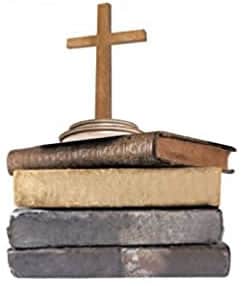
The Parallel Lives
Of The NOBLE AMERICAN RELIGIOUS THINKERS AND BELIEVERS:
Roger Williams VS. Cotton Mathers

NEW ARTICLES
Three Events on February 11, 1861
Black History Month began Sunday, February 1, and will end Sunday, March 1. At least three events occurred on February 11, 1861, that deserve our attention during Black History Month.
On that day, the U.S. House of Representatives received a formal written notification from South Carolina’s four Representatives, that informed House members that on December 20, 1860, officials in South Carolina had voted to secede from the United States of America.
On that same day, the House’s members passed a resolution that read, “That neither Congress, the People, nor the Governments of the Non-slaveholding States have the constitutional right to legislate upon or interfere with slavery in any of the Slaveholding States of the Union.”
The resolution passed 161 yea’s, and no nay’s.
On that same day, in Illinois, President-elect Abraham Lincoln departed from Springfield, on a journey by train to Washington D.C., and to the White House.
The three events inter-connect. South Carolina chose to secede from the Union because Lincoln, a Republican—one who stood firm against the expansion of slavery into the western territories—had won the Presidential election held on November 6, 1860.
Members of the House passed its resolution in a frantic attempt to appease southern states, who feared Lincoln and the future of slavery under a Republican administration.
Southerners understood that the vast amount of each of their states’ wealth originated from slave labor. They could not imagine a future without slavery.
That House Resolution was already too late. By February 11, seven states had seceded from the Union: South Carolina, in December 1860; Mississippi, Florida, Alabama, Georgia, and Louisiana, in January 1861; and Texas, on February 1, 1861.
There were an additional eight slave-holding states, and the fear throughout Washington D. C. was that all eight too would secede.
Abraham Lincoln arrived in Washington D.C. on the morning of February 23. Days later, on March 4, 1861, Lincoln took the oath of office. In his Inaugural Address, Lincoln tried to soothe the southern states. He said,
“Apprehension seems to exist among the people of the Southern States that by the accession of a Republican Administration, their property and their peace and personal security are to be endangered. There has never been any reasonable cause for such apprehension.
“I have no purpose, directly or indirectly, to interfere with the institution of slavery in the States where it exists. I believe I have no lawful right to do so, and I have no inclination to do so.
“We are not enemies, but friends. We must not be enemies. Though passion may have strained, it must not break our bonds of affection.”
Despite Lincoln’s calming words, four more southern states seceded from the Union: Virginia, in April; Arkansas and North Carolina, in May; and Tennessee, in June, a total of eleven states.
The United States had split into two countries, two governments, two presidents.
One glimmer of hope: four slave-holding states, those just south of the Mason-Dixon line, remained in the Union: Delaware, Maryland, Kentucky, and Missouri.
Historians now consider the southern states’ secession a colossal mistake. Around 300,000 Southern white men were killed during the Civil War, a war that crushed the South’s economy and abolished slavery. Plus, the Southern states lost their votes in Congress, and it was treason.
The war commenced April 12, 1861, when Southern troops fired on Fort Sumter, in Charleston’s harbor. February 11, 1861, a day of missed opportunity to defer a Civil War.
White Christmas
White ChristmasThe crooner Bing Crosby first sang “White Christmas” live on the “Kraft Music Hall” radio show on December 26, 1941, nineteen days after the Japanese attacked Pearl Harbor. It was a frightening time, one of our country’s darkest moments. The nation felt...
Two weddings
Twenty-eight-year-old Naomi Biden married twenty-five-year-old Peter Neal on the south lawn, at the White House, on Saturday, November 19, 2022, beginning at 11:00 a.m. Eastern time.
Because there was no tent, and because the temperature was a chilly 39 degrees, some 250 guests received shawls, hand-warmers, and blankets once they arrived. They also checked in their cell phones.
Thoughts on Thanksgiving
Elias Boudinot, a member of Congress in the new Federal Government, introduced a resolution in 1789, to form a joint committee that asked President George Washington to call for a day of prayer and thanksgiving. That joint resolution passed both Senate and House. Washington chose to respond.
On October 3, 1789, he called for a day of “Public Thanksgiving and Prayer,” that he set for Thursday, November 26, 1789. Washington celebrated that early Thanksgiving, by attending services at St. Paul’s Chapel, and giving beer and food to those in jail for failing to pay their bills.
Two Veterans
Two VeteransDavid McCullough, biographer and historian, passed away on August 7, 2022, at age 89. His biographies—on Harry Truman, John Adams, and Theodore Roosevelt; and his histories on the Johnstown Flood, the Panama Canal, and the Brooklyn Bridge—earned him prizes...
Phantom of the Opera
Phantom of the OperaGaston Leroux published his novel, “Le Fantome de l’Opera,” or “Phantom of the Opera,” in 1911. Earlier he had worked as a theatre critic for a French newspaper, the “L’Echo de Paris,” and had heard talk of a chandelier, fastened above the crowd,...
Tact
TactNews broke early this month that school officials at New York University fired an adjunct organic chemistry professor named Dr. Maitland Jones, after 82 of his class of 350 students signed a petition, that charged Jones with making the class too hard. The mean...
Older Posts
‘On Writing’ and ‘Why I Write’
n the year 2000, the horror fiction writer Stephen King came out with a different kind of book, a nonfiction book that he entitled, “On Writing: a Memoir of the Craft.” He begins with a series of scenes from his childhood, and explains how he launched his career of writing popular fiction.
King uses a metaphor, that of a toolbox, to describe how he works when he writes. At the bottom of the toolbox lie the fundamentals: appropriate vocabulary, sticking with accepted grammar, the use of active verbs rather than passive, and avoiding adverbs.
Recap of Queen Elizabeth II
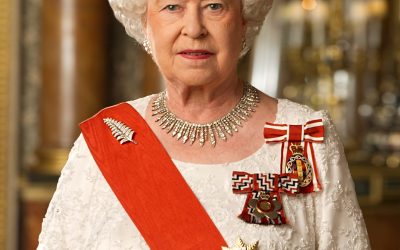
Queen Elizabeth II of New ZealandQueen Elizabeth passed away last week, Thursday, September 8, 2022, at 96. She was born on April 21, 1926, and had one sibling, a younger sister named Margaret, born August 21, 1930. When ten, Elizabeth discovered she was next in line...
Vaclav Smil
Vaclav Smil was born in 1943, during World War II, in Czechoslovakia, in the German Protectorate of Bohemia and Moravia. As a teenager, Smil’s parents expected him to chop wood, every four hours, to keep the fires burning in the house’s three stoves, “one downstairs and two up.”
One writer suspected that Smil may have thought then that “this is hardly an efficient way to live.”
Bill Russell and Retirement
Three weeks ago, on July 31, 2022, the former Boston Celtics’ imposing center, Bill Russell, passed away, at age eighty-eight. Over thirteen seasons at Boston, from 1957 to 1969, he collected a total of eleven championship rings, a record never since eclipsed or matched.
When he retired in 1969, he moved to Mercer Island, in Seattle, Washington, and it was there he passed away. For fifty-three years, he enjoyed a well-deserved retirement in the cool Pacific Northwest, although he coached seven seasons in the NBA in the 70s and 80s.
Battle at Rzhev
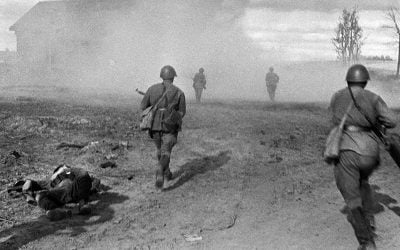
In the early days of World War II, 1939 to 1940, the Nazi German war machine advanced across eastern Europe, until its soldiers stood on the outskirts of Moscow, deep into the Soviet Union, poised and ready to attack the Russian capital city.
However, the Battle of Moscow stalled when the Soviet’s Red Army found sufficient strength to initiate a counter offensive, at Joseph Stalin’s insistence, that pushed Germany’s 9th Army west, some distance from Moscow. The counter-offensive worked for a time, until the German army stopped.
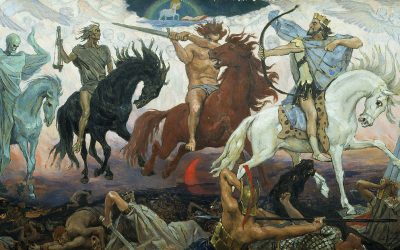
IN RETROSPECT: Pestilence
IN RETROSPECT: Pestilence On June 26, 1284, officials in a German town called Hamelin hired a musician to rid the town of its rats. The “rat-catcher’s magical flute” hypnotized the rats that followed the piper out of Hamelin’s gates and into the Weser River, where...

One of University of Northern Colorado’s 2020 Honored Alumni
William H. Benson
Local has provided scholarships for history students for 15 years
A Sterling resident is among five alumni selected to be recognized this year by the University of Northern Colorado. Bill Benson is one of college’s 2020 Honored Alumni.
Each year UNC honors alumni in recognition for their outstanding contributions to the college, their profession and their community. This year’s honorees were to be recognized at an awards ceremony on March 27, but due to the COVID-19 outbreak that event has been cancelled. Instead UNC will recognize the honorees in the fall during homecoming Oct. 10 and 11……
Newspaper Columns

The Duodecimal System
For centuries, the ancient Romans calculated sums with their clunky numerals: I, V, X, L, C, D, and M; or one, five, ten, 50, 100, 500, and 1,000. They knew nothing better.

The Thirteenth Amendment
On Jan. 1, 1863, President Abraham Lincoln signed the Emancipation Proclamation, and by it, he declared that “all persons held as slaves” within the rebellious states “are and henceforward shall be free.” Lincoln’s Proclamation freed some 3.1 million slaves within the Confederacy.

The Fourteenth Amendment
After Congress and enough states ratified the thirteenth amendment that terminated slavery, Congress passed the Civil Rights Act of 1866. This law declared that “all people born in the United States are entitled to be citizens, without regard to race, color, or previous condition of slavery or involuntary servitude.” The Act equated birth to citizenship.

The New-York Packet and the Constitution
Jill Lepore, the Harvard historian, published her newest book a month ago, These Truths: A History of the United States. In a short introduction, she describes in detail the Oct. 30, 1787 edition of a semi-weekly newspaper, The New-York Packet.
Mr. Benson’s writings on the U.S. Constitution are a great addition to the South Platte Sentinel. Its inspiring to see the history of the highest laws of this country passed on to others.
– Richard Hogan
Mr. Benson, I cannot thank you enough for this scholarship. As a first-generation college student, the prospect of finding a way to afford college is a very daunting one. Thanks to your generous donation, my dream of attending UNC and continuing my success here is far more achievable
– Cedric Sage Nixon
Donec bibendum tortor non vestibulum dapibus. Cras id tempor risus. Curabitur eu dui pellentesque, pharetra purus viverra.
– Extra Times
FUTURE BOOKS
- Thomas Paine vs. George Whitefield
- Ralph Waldo Emerson vs. Joseph Smith
- William James vs. Mary Baker Eddy
- Mark Twain vs. Billy Graham
- Henry Louis Mencken vs. Jim Bakker
