
By William H. Benson
The Parallel Lives
Of The NOBLE AMERICAN RELIGIOUS THINKERS AND BELIEVERS:
Roger Williams VS. Cotton Mathers

NEW ARTICLES
Black History Month: Reconstruction, 1865-1866
In December of 1863, in the midst of the Civil War, President Abraham Lincoln suggested a plan to reinstate the seceded states back into the Union, his “Ten Percent Plan.”
He would permit each Confederate state to form a new state government after ten percent of the voters in a state took loyalty oaths to the Union and recognized the former slaves’ freedom.
Following Lincoln’s assassination on April 9, 1865, his successor, former Vice-President Andrew Johnson, decided to run with Lincoln’s Ten Percent Plan.
Throughout the summer and fall of 1866, the Southern states held special state conventions. At them, they repealed secession, repudiated all Confederate debts, ratified the 13th Amendment that outlawed slavery, and held elections, all in accord with the Ten Percent Plan.
Those elected to various offices in these new state governments included: four former Confederate generals, five colonels, members of the Confederate government’s cabinet, plus Alexander Stephens, the Confederacy’s former Vice-President, who was indicted for treason.
President Johnson felt embarrassed that a series of former Confederates were back in power.
The one constant in these new state governments was their utter contempt for the former slaves, whom they considered “unfit, “inferior,” and “incapable of self-government.”
The new state governments passed a series of Black Codes, designed to keep the former slave poor, stuck at the bottom of the social ladder, with no opportunity for advancement.
Vagrancy laws within the Black Codes forced blacks into contracted labor on a plantation’s fields. Also, the Black Codes denied the former slaves equal protection under the law.
The former slaves convened at their own conventions, called Colored Conventions. At them, delegates discussed “labor, health care, temperance, emigration, voting rights, trial by jury, and education.” Anyone can read the convention’s minutes at the “Colored Conventions Project.”
On December 4, 1865, when the Thirty-Ninth Congress first convened in Washington D.C., Northern Republicans were dismayed to see former Confederates try to walk into the Capitol and assume a seat. They slammed the door in their faces, and Congress’s clerk refused to seat them.
They were called names: “impudent claimants,” “unrepentant,” and “former enemies.”
Thaddeus Stevens, a Republican in the House,” said, “Dead states cannot restore their existence. Congress must create states and declare when they are entitled to be represented.”
Both Presidential and Confederate Reconstruction had ended, but now Congressional Reconstruction was set to begin. A “spirit of revenge” motived these Radical Republicans to act.
On Dec. 13, 1865, Congress formed a Joint Committee of Fifteen on Reconstruction, composed of nine Representatives and six Senators to investigate and determine under what terms the seceded states might regain their status as a state, plus congressional representation.
The committee interviewed “144 witnesses, including 77 Northerners living in the South, 8 Blacks, and 57 Southerners,” and produced “more than 700 pages of testimony, a dreary recital of inhumanity,” of how whites mistreated the former slaves throughout the Southern states.
The committee first recommended further support for the Freedmen’s Bureau, intended to provide relief, food, and schools for the blacks. It also recommended a civil rights bill.
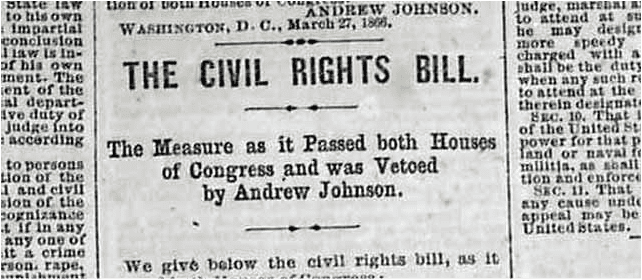
On April 9, 1866, Congress passed the Civil Rights Act of 1866, by a two-thirds vote over President Johnson’s veto. It declared that “all persons born in the United States were citizens,” “without distinction of race or color or previous condition of slavery or involuntary servitude.”
This Act was unique, the first United States federal law to define what persons are citizens.
Black History Month ends this week.
Reconstruction is a messy history. Some consider it a low point in American history. Others, including Eric Foner, historian at Columbia University, label it our nation’s “Second Founding.”
More next time on Reconstruction in these pages, thoughts on the 14th Amendment.
THE BERLIN WALL
THE BERLIN WALLTHE BERLIN WALL by William H. Benson June 23, 2011 On March 5, 1946, less than a year after the conclusion of World War II, Winston Churchill spoke at Westminster College in Fulton, Missouri and said, “From Stettin in the Baltic to Trieste in the...
BILL CLINTON’S INDISCRETIONS
BILL CLINTON'S INDISCRETIONSBILL CLINTON'S INDISCRETIONS by William H. Benson June 9, 2011 June is the month for weddings and for celebrating Father's Day, a season and a day for happily reuniting with family and relatives. And yet, for some, the recent news...
MAJOR GENERAL BENJAMIN F. BUTLER
MAJOR GENERAL BENJAMIN F. BUTLERMAJOR GENERAL BENJAMIN F. BUTLER by William H. Benson May 26, 2011 On Wednesday, May 22, 1861, Major General Benjamin F. Butler arrived at his new command at Fort Monroe, Virginia, a fortress under Union control and located at the...
OSAMA BIN LADEN VS. ROGER WILLIAMS
OSAMA BIN LADEN VS. ROGER WILLIAMSOSAMA BIN LADEN VS. ROGER WILLIAMS by William H. Benson May 12, 2011 Michael Reagan, the former President's son, submitted his opinion of Osama bin Laden's demise. “They got him. Put a couple of slugs in his face. Then they...
EDWIN HUBBLE
EDWIN HUBBLEEDWIN HUBBLE by William H. Benson April 28, 2011 Edwin Hubble was born in a small town in Missouri but grew up in Wheaton, Illinois. Even though he excelled at athletics after the turn of the century, and was exceedingly intelligent, he frequently...
HEINRICH SCHLIEMANN
HEINRICH SCHLIEMANNHEINRICH SCHLIEMANN by William H. Benson April 14, 2011 Recently, I re-read the story of how Heinrich Schliemann dug up the ancient city of Troy. When a child in Germany, Schliemann loved to read Homer's stories of the Trojan war in the...
Older Posts
GEOGRAPHIC BEE
GEOGRAPHIC BEEGEOGRAPHIC BEE by William H. Benson March 31, 2011 I read in Newsweek last week where certain Republicans are now tentatively campaigning in New Hampshire; specifically those 2012 Presidential hopefuls, such as Tim Pawlenty, and Minnesota's...
THE LUCK OF THE IRISH
THE LUCK OF THE IRISHTHE LUCK OF THE IRISH by William H. Benson March 17, 2011 Jed Clampett of The Beverly Hillbillies once explained to his nephew Jethro how he saw through the intentions of a designing and matrimonial-minded woman. “Well, Jethro,” he said. “Us...
MENTAL ATHLETES
MENTAL ATHLETESMENTAL ATHLETES by William H. Benson March 3, 2011 In last Sunday's New York Times Magazine, I read an interesting article on mental athletes, or M.A.'s for short. These individuals compete at memory games: for example, they memorize thousands of...
MARK TWAIN VS. GARRISON KEILLOR
MARK TWAIN VS. GARRISON KEILLORMARK TWAIN VS. GARRISON KEILLOR by William H. Benson February 19, 2011 Mark Twain is a bestseller—number 4 last week on the New York Times Book Review list—for the publication of the first volume of his autobiography. He would be...
ROGER WILLIAMS
ROGER WILLIAMSROGER WILLIAMS by William H. Benson February 3, 2011 Roger Williams, the English Puritan clergyman, arrived in New England on February 5, 1631, just months after the colony's inception. He was twenty-eight years old, educated at Pembroke Hall,...
IKE
IKEIKE by William H. Benson January 20, 2011 On January 20, 1953, on the steps of the Capitol, General Dwight David Eisenhower, or “Ike” took the oath of office and was sworn in as our nation's thirty-fourth President. Before delivering his Inaugural Address, he...

One of University of Northern Colorado’s 2020 Honored Alumni
William H. Benson
Local has provided scholarships for history students for 15 years
A Sterling resident is among five alumni selected to be recognized this year by the University of Northern Colorado. Bill Benson is one of college’s 2020 Honored Alumni.
Each year UNC honors alumni in recognition for their outstanding contributions to the college, their profession and their community. This year’s honorees were to be recognized at an awards ceremony on March 27, but due to the COVID-19 outbreak that event has been cancelled. Instead UNC will recognize the honorees in the fall during homecoming Oct. 10 and 11……
Newspaper Columns

The Duodecimal System
For centuries, the ancient Romans calculated sums with their clunky numerals: I, V, X, L, C, D, and M; or one, five, ten, 50, 100, 500, and 1,000. They knew nothing better.

The Thirteenth Amendment
On Jan. 1, 1863, President Abraham Lincoln signed the Emancipation Proclamation, and by it, he declared that “all persons held as slaves” within the rebellious states “are and henceforward shall be free.” Lincoln’s Proclamation freed some 3.1 million slaves within the Confederacy.

The Fourteenth Amendment
After Congress and enough states ratified the thirteenth amendment that terminated slavery, Congress passed the Civil Rights Act of 1866. This law declared that “all people born in the United States are entitled to be citizens, without regard to race, color, or previous condition of slavery or involuntary servitude.” The Act equated birth to citizenship.

The New-York Packet and the Constitution
Jill Lepore, the Harvard historian, published her newest book a month ago, These Truths: A History of the United States. In a short introduction, she describes in detail the Oct. 30, 1787 edition of a semi-weekly newspaper, The New-York Packet.
Mr. Benson’s writings on the U.S. Constitution are a great addition to the South Platte Sentinel. Its inspiring to see the history of the highest laws of this country passed on to others.
– Richard Hogan
Mr. Benson, I cannot thank you enough for this scholarship. As a first-generation college student, the prospect of finding a way to afford college is a very daunting one. Thanks to your generous donation, my dream of attending UNC and continuing my success here is far more achievable
– Cedric Sage Nixon
Donec bibendum tortor non vestibulum dapibus. Cras id tempor risus. Curabitur eu dui pellentesque, pharetra purus viverra.
– Extra Times
FUTURE BOOKS
- Thomas Paine vs. George Whitefield
- Ralph Waldo Emerson vs. Joseph Smith
- William James vs. Mary Baker Eddy
- Mark Twain vs. Billy Graham
- Henry Louis Mencken vs. Jim Bakker
