
By William H. Benson
The Parallel Lives
Of The NOBLE AMERICAN RELIGIOUS THINKERS AND BELIEVERS:
Roger Williams VS. Cotton Mathers

NEW ARTICLES
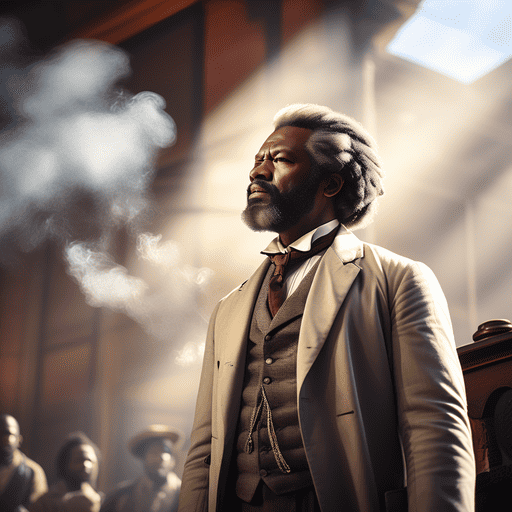
Frederick Douglass’ “Slaveholder’s Sermon”
David Blight teaches Civil War and Reconstruction history at Yale University. In 2018, Blight published a biography on the abolitionist Frederick Douglass, entitled, “Frederick Douglass: Prophet of Freedom.”
Blight tells a remarkable story. His biography deserved and did win the Pulitzer Prize in 2019.
Blight describes Douglass as a spell-binding lecturer through most of the nineteenth century, who left audiences both weeping and laughing, their emotions whipsawed by his incredible story of how he escaped from oppression and a brutal form of slavery in eastern Maryland.
Few of those who heard him speak could understand how this black man, who displayed awe-inspiring and phenomenal language skills on the lecture circuit, could have once worked as an uneducated field hand. Audiences wanted to know, “How did his transformation happen?”
Douglass was an autodidact, self-taught. It was an intense struggle, but on his own and in secret he learned to read. In slave-holding states laws on the books prevented white people from teaching black slaves how to read or write. Yet, Douglass was determined to master words.
In his lectures, Douglass often described his horrible days as a slave, drawing upon vivid details of how his owners would whip him, and that the scars across his back were proof.
On a given night on a stage somewhere in the northern states, in the 1840’s, Douglass would stand and say that he was there to spread light. “There is nothing slavery dislikes half so much as the light. It is a gigantic system of iniquity, that feeds and lives in darkness.”
He said that for down-trodden slaves the Bill of Rights was “the Bill of Wrongs,” and that self-evident truths were “self-evident lies.”
Crowds loved that part of Douglass’s lecture that Blight called “The Slaveholder’s Sermon.” In it, Douglass would mimic a Southern white preacher, who would talk down to the blacks.
“And you too, my friends, have souls of infinite value, souls that will live through endless happiness or misery in eternity. Oh, labor diligently to make your calling and election sure. Oh, receive into your souls these words of the holy apostle, ‘Servants, be obedient to your masters.’
“Oh, consider the wonderful goodness of God! Look at your hard hands, your strong muscular frames, and see how he has adapted you to the duties you are to fulfill.
“Look at your masters, who have slender frames and long delicate fingers. God has given them brilliant intellects, that they may do the thinking, while you do the working.”
While audiences laughed at his depiction of the Southern white preacher’s sermon, Douglass would recite the Golden Rule, and stare at his audience. The contrast was obvious.
Douglass would say, “In America, Bibles and slaveholders go hand in hand. The church and the slave prison stand together. While you hear the chanting of psalms in one, you hear the clanking of chains in the other.
“The man who wields the cowhide during the week, fills the pulpit on Sunday. The man who whipped me in the week used to show me the way of life on the Sabbath.”
In Douglass’s hands, “The Slaveholder’s Sermon” drew attention to the rankest form of Christian hypocrisy that existed throughout the fourteen slave-holding Southern states, a fact of life that all slaves faced every day. Yet, no slave dared to point it out, save for Douglass.
David Blight wrote, “A star had been born; a youthful, brilliant black voice of a fugitive slave had entered the fray of abolitionism.”
One hundred and twenty years before Martin Luther King, Jr. thrilled audiences with his uplifting and awe-inspiring words, Frederick Douglass did the same.
On September 22, 1862, President Abraham Lincoln freed four million slaves by the Emancipation Proclamation in the midst of a bloody Civil War. It took effect on January 1, 1863.
REVOLUTIONS AND CHINA
REVOLUTIONS AND CHINAREVOLUTIONS AND CHINA by William H. Benson October 1, 2010 When in high school, nearly forty years ago, I remember the day when, either late in September or in early October, a fellow student, as he was heading up his math paper, blurted out...
JAMES FENIMORE COOPER VS. AGATHA CHRISTIE
JAMES FENIMORE COOPER VS. AGATHA CHRISTIEJAMES FENIMORE COOPER VS. AGATHA CHRISTIE by William H. Benson September 15, 2010 Born on this day, September 15, in 1789 was the American author James Fenimore Cooper. Because he inherited his father's vast...
THE CRUSADES
THE CRUSADESTHE CRUSADES by William H. Benson September 2, 2010 Soldiers from western Europe invaded Palestine, that narrow strip of land along the eastern coast of the Mediterranean Sea with the intention of establishing a Western colony there. These warriors...
COMPETENCY VS. CREATIVITY
COMPETENCY VS. CREATIVITYCOMPETENCY VS. CREATIVITY by William H. Benson August 19, 2010 This past weekend I read in The New York Times Magazine of an online board game called “Bring It,” in which players draw from a deck of cards a series of math questions....
HUGO CHAVEZ VS. SIMON BOLIVAR
HUGO CHAVEZ VS. SIMON BOLIVARHUGO CHAVEZ VS. SIMON BOLIVAR by William H. Benson August 5, 2010 Across my desk last week came an interesting quote: “The unreal is more powerful than the real, because nothing is as perfect as you can imagine it, because it’s only...
DON KNOTTS
DON KNOTTSDON KNOTTS by William H. Benson July 22, 2010 Jesse Don Knotts was born on July 21, 1924 in Morgantown, West Virginia into a truly dysfunctional family. The last of four sons, Don slept in the kitchen so that his mother could rent out his room to...
Older Posts
THE OTHER WES MOORE
THE OTHER WES MOORETHE OTHER WES MOORE by William H. Benson July 8, 2010 A book review in the Denver Post last week caught my attention. It told of a book written by a banker named Wes Moore and was entitled The Other Wes Moore. In it, Moore recounts the details...
MIDSUMMER DAY FESTIVAL
MIDSUMMER DAY FESTIVALMIDSUMMER DAY FESTIVAL by William H. Benson June 24, 2010 For fun this summer, I read the first of Stieg Larsson’s three mystery novels, The Girl With the Dragon Tattoo. In it, Larsson, a Swedish author, tells the story of a missing person,...
A STATISTICAL ANOMALY
A STATISTICAL ANOMALYA STATISTICAL ANOMALY by William H. Benson June 10, 2010 Vikas Swarup of India published his debut novel, Q & A, in 2005. Told in first person, the story is that of Ram Mohammad Thomas, an eighteen-year-old waiter who survived a multitude...
MEMORIES
MEMORIESMEMORIES by William H. Benson May 27, 2010 “Precious Memories, how they linger,” sings the Gospel singer. Ralph Waldo Emerson, born on May 25, in 1803, hinted at those “lingering” memories, seemingly jointly held: “There is one mind common to...
JANE FRANKLIN MECOM
JANE FRANKLIN MECOMJANE FRANKLIN MECOM by William H. Benson May 13, 2010 Benjamin Franklin’s father, Josiah Franklin, was married four times, and by two of those wives, he produced seventeen children: Elizabeth, Samuel, Hannah, Josiah, Anne, Joseph I, and...
EVIDENCE
EVIDENCEEVIDENCE by William H. Benson April 29, 2010 An English word that has drifted out of common usage is the word “pseudodox,” meaning a false idea or untrue opinion, but perhaps it is time to bring the word back. Today, April 29, 2010, marks the...

One of University of Northern Colorado’s 2020 Honored Alumni
William H. Benson
Local has provided scholarships for history students for 15 years
A Sterling resident is among five alumni selected to be recognized this year by the University of Northern Colorado. Bill Benson is one of college’s 2020 Honored Alumni.
Each year UNC honors alumni in recognition for their outstanding contributions to the college, their profession and their community. This year’s honorees were to be recognized at an awards ceremony on March 27, but due to the COVID-19 outbreak that event has been cancelled. Instead UNC will recognize the honorees in the fall during homecoming Oct. 10 and 11……
Newspaper Columns

The Duodecimal System
For centuries, the ancient Romans calculated sums with their clunky numerals: I, V, X, L, C, D, and M; or one, five, ten, 50, 100, 500, and 1,000. They knew nothing better.

The Thirteenth Amendment
On Jan. 1, 1863, President Abraham Lincoln signed the Emancipation Proclamation, and by it, he declared that “all persons held as slaves” within the rebellious states “are and henceforward shall be free.” Lincoln’s Proclamation freed some 3.1 million slaves within the Confederacy.

The Fourteenth Amendment
After Congress and enough states ratified the thirteenth amendment that terminated slavery, Congress passed the Civil Rights Act of 1866. This law declared that “all people born in the United States are entitled to be citizens, without regard to race, color, or previous condition of slavery or involuntary servitude.” The Act equated birth to citizenship.

The New-York Packet and the Constitution
Jill Lepore, the Harvard historian, published her newest book a month ago, These Truths: A History of the United States. In a short introduction, she describes in detail the Oct. 30, 1787 edition of a semi-weekly newspaper, The New-York Packet.
Mr. Benson’s writings on the U.S. Constitution are a great addition to the South Platte Sentinel. Its inspiring to see the history of the highest laws of this country passed on to others.
– Richard Hogan
Mr. Benson, I cannot thank you enough for this scholarship. As a first-generation college student, the prospect of finding a way to afford college is a very daunting one. Thanks to your generous donation, my dream of attending UNC and continuing my success here is far more achievable
– Cedric Sage Nixon
Donec bibendum tortor non vestibulum dapibus. Cras id tempor risus. Curabitur eu dui pellentesque, pharetra purus viverra.
– Extra Times
FUTURE BOOKS
- Thomas Paine vs. George Whitefield
- Ralph Waldo Emerson vs. Joseph Smith
- William James vs. Mary Baker Eddy
- Mark Twain vs. Billy Graham
- Henry Louis Mencken vs. Jim Bakker
