
By William H. Benson
The Parallel Lives
Of The NOBLE AMERICAN RELIGIOUS THINKERS AND BELIEVERS:
Roger Williams VS. Cotton Mathers

NEW ARTICLES
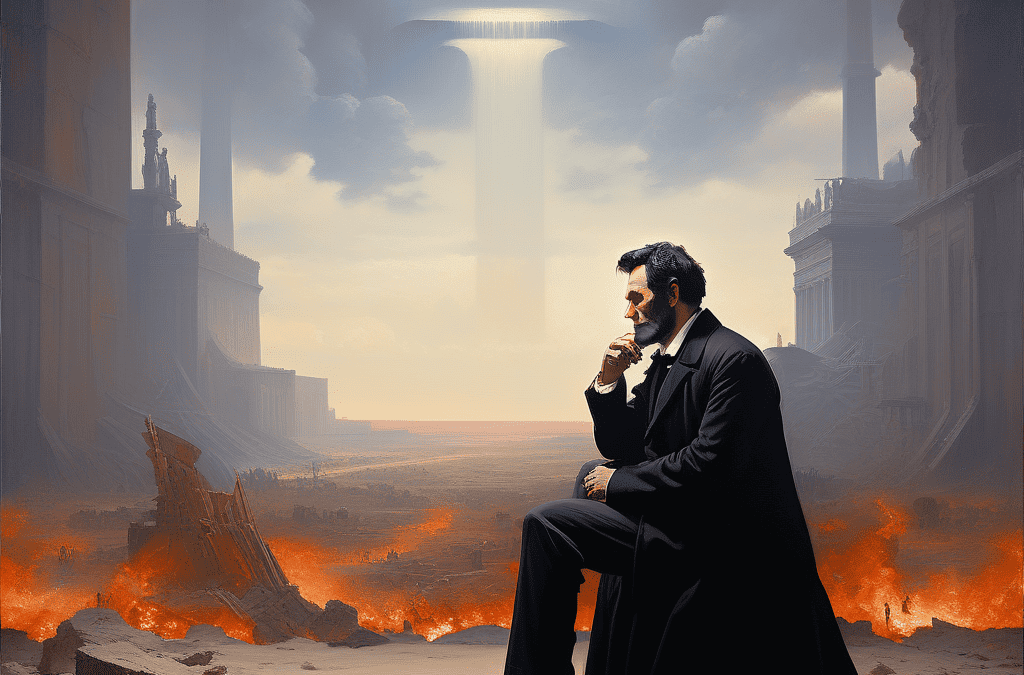
Secession and Abraham Lincoln
Secession and Abraham Lincoln
Abraham Lincoln faced an absolute calamity on March 4, 1861, the day when Chief Justice Roger Taney administered the oath of office to Lincoln at his inauguration.
Already seven states from the South had seceded, or withdrawn, from the Union because voters had elected Lincoln President of the United States. Southern voters believed that Lincoln opposed the expansion of slavery into western territories, like Kansas and Nebraska.
South Carolina voted to secede on December 20, 1860, forty-four days after the November 6 election, and it went into effect on Christmas Eve. Mississippi, Florida, Alabama, Georgia, and Louisiana followed suit after Christmas, in January of 1861, and Texas on February 1.
Lincoln understood that another eight slave states might also secede from the Union soon.
On that day in March, 1861, Lincoln placed his hand on the Bible and said, “I do solemnly swear that I will faithfully execute the Office of President of the United States, and will to the best of my ability, preserve, protect, and defend the Constitution of the United States.”
He then delivered his first Inaugural Address, saying, “The central idea of secession is the essence of anarchy. A majority is the only true sovereign of a free people. Whoever rejects it does fly to anarchy or despotism. The rule of a minority is wholly inadmissible.”
Almost three years before, on June 16, 1858, Lincoln had delivered an address at the Republican State convention, in Springfield, Illinois, and had discussed the issue of “slavery agitation.” Historians since have entitled his talk, the “House Divided” speech. In it, he said,
“In my opinion, it will not cease, until a crisis shall have been reached, and passed. ‘A house divided against itself cannot stand.’ (That is a quote from the Gospel of Matthew.) I believe this government cannot endure, permanently half slave and half free.
“I do not expect the Union to be dissolved—I do not expect the house to fall—but I do expect it will cease to be divided. It will become all one thing, or all the other.”
Southerners read Lincoln’s speech and were convinced that he had aligned himself with Northern agitators, and that he was anxious to eradicate the South’s primary labor force.
Because they felt threatened, even fearful, certain Southern states chose to secede from the Union and create a new country, the Confederate States of America.
Delegates from the seven Southern states assembled in Montgomery, Alabama, in early February of 1861, to adopt a provisional constitution for the Confederate States, elect Jefferson Davis their president for the next six years, and adopt a flag for their new country.
Delegates from North Carolina arrived in Montgomery on February 6, “to plead in vain for conciliation,” wit the Northern states, and so they left, feeling dismayed.
On April 12, 1861, thirty-nine days after Lincoln’s inauguration, a line of canons poised at Charleston, South Carolina fired upon Fort Sumter, four miles out in Charleston’s harbor, the opening shots of the Civil War.
Inside the fort, the stars and stripes came down, and the Confederate flag was hoisted high. North and South were now locked into a bloody conflict to see whose set of ideas would win.
On April 17, Virginia seceded and joined the Confederacy. In May, Arkansas and North Carolina seceded, and on June 8, Tennessee did the same. A total of eleven states seceded.
Years before, on September 12, 1854, Lincoln gave an insightful speech at Bloomington, Illinois, about the differences between North and South. He said that,
“The Southern slaveholders were neither better, nor worse than we of the North, and that we of the North were no better than they. If we were situated as they are, we should act and feel as they do; and if they were situated as we are, they should act and feel as we do.
“And we never ought to lose sight of this fact in discussing the subject.”
Steven Inskeep, author of a new book, “Differ We Must,” said that Lincoln believed that,
“Slaveholders were not bad people, but people caught up in a bad system, which they naturally acted out of self-interest to defend. Lincoln’s quarrel was not with them, but with their circumstances.”
No president before or since Lincoln has faced as bad a calamity as he did in 1861.
POWER AND POETRY
POWER AND POETRYPOWER AND POETRY by William H. Benson January 21, 2010 John F. Kennedy and Robert Frost met on the steps of the Capitol on January 20, 1961 at the inauguration of the 35th President of the United States. Kennedy’s associate, Stewart Udall, had...
SHERLOCK HOLMES AND 2010
SHERLOCK HOLMES AND 2010SHERLOCK HOLMES AND 2010 by William H. Benson January 14, 2010 Robert Downey, Jr. stars in the new Sherlock Holmes movie that Hollywood released this past Christmas season. Because it is an intricately-woven plot with a fair number of...
JIM BAKKER’S CHRISTMAS
JIM BAKKER’S CHRISTMASJIM BAKKER’S CHRISTMAS by William H. Benson December 24, 2009 Jim Bakker’s Christmas at Heritage USA was a spectacular production, a seasonal extravaganza, and a destination point for sightseers from near and far. Called the Christmas City...
KING EDWARD VIII ABDICATES
KING EDWARD VIII ABDICATESKING EDWARD VIII ABDICATES by William H. Benson December 10, 2009 Edward Albert Christian George Andrew Patrick David was born in 1894, into the House of Windsor, the son of George V, King of the British Empire, and Queen Mary. Being the...
THE CURSE OF KNOWLEDGE
THE CURSE OF KNOWLEDGETHE CURSE OF KNOWLEDGE by William H. Benson November 26, 2009 In last week’s New York Times Book Review, I caught the following comment: “Academics lack perspective. In a debate on whether the world is round, they would argue, ‘no,’ because...
DIVISIONS
DIVISIONSDIVISIONS by William H. Benson November 12, 2009 Charles Darwin decided at the age of 29 he should marry, and he arrived at that decision in his methodical manner—by listing the pros and cons on a piece of paper. Listed among the advantages, he wrote,...
Older Posts
EDGAR ALLAN POE AND HALLOWEEN
EDGAR ALLAN POE AND HALLOWEENEDGAR ALLAN POE AND HALLOWEEN by William H. Benson October 29, 2009 In 1831, then at the age of twenty-two, Edgar Allan Poe decided that he would try to make a career as a writer of poetry and short stories. Over the course of the...
CHRISTOPHER COLUMBUS
CHRISTOPHER COLUMBUSCHRISTOPHER COLUMBUS by William H. Benson October 15, 2009 In 1995, James W. Loewen published a book he entitled Lies My Teacher Told Me, in which he released the results of his survey of a dozen different high school American history...
CHARLES SCHULZ
CHARLES SCHULZCHARLES SCHULZ by William H. Benson October 1, 2009 On October 2, 1950, Charles Schulz first published his Peanuts comic strip, featuring Charlie Brown, his dog Snoopy, and the others: Lucy, Linus, Sally, Schroeder, and Peppermint Patty. Schulz...
EXPLOSION IN NEW YORK CITY
EXPLOSION IN NEW YORK CITYEXPLOSION IN NEW YORK CITY by William H. Benson September 17, 2009 At noon on September 16, 1920, a horse-drawn cart pulled up near J. P. Morgan’s headquarters at the corner of Broad and Wall Street at the south end of Manhattan. The...
THOUGHTS ON PLANET EARTH
THOUGHTS ON PLANET EARTHTHOUGHTS ON PLANET EARTH by William H. Benson September 3, 2009 Over the eons, our planet, Earth, has staggered violently between centuries of sweltering heat or brutal chill. Cycles of global cooling followed by global warming have been...
CARTER’S NATIONAL MALAISE SPEECH
CARTER’S NATIONAL MALAISE SPEECHCARTER’S NATIONAL MALAISE SPEECH by William H. Benson August 20, 2009 The 1970s seemed a disaster for our country. It was a time of faltering American military power relative to the Soviets, productivity declines in our nation’s...

One of University of Northern Colorado’s 2020 Honored Alumni
William H. Benson
Local has provided scholarships for history students for 15 years
A Sterling resident is among five alumni selected to be recognized this year by the University of Northern Colorado. Bill Benson is one of college’s 2020 Honored Alumni.
Each year UNC honors alumni in recognition for their outstanding contributions to the college, their profession and their community. This year’s honorees were to be recognized at an awards ceremony on March 27, but due to the COVID-19 outbreak that event has been cancelled. Instead UNC will recognize the honorees in the fall during homecoming Oct. 10 and 11……
Newspaper Columns

The Duodecimal System
For centuries, the ancient Romans calculated sums with their clunky numerals: I, V, X, L, C, D, and M; or one, five, ten, 50, 100, 500, and 1,000. They knew nothing better.

The Thirteenth Amendment
On Jan. 1, 1863, President Abraham Lincoln signed the Emancipation Proclamation, and by it, he declared that “all persons held as slaves” within the rebellious states “are and henceforward shall be free.” Lincoln’s Proclamation freed some 3.1 million slaves within the Confederacy.

The Fourteenth Amendment
After Congress and enough states ratified the thirteenth amendment that terminated slavery, Congress passed the Civil Rights Act of 1866. This law declared that “all people born in the United States are entitled to be citizens, without regard to race, color, or previous condition of slavery or involuntary servitude.” The Act equated birth to citizenship.

The New-York Packet and the Constitution
Jill Lepore, the Harvard historian, published her newest book a month ago, These Truths: A History of the United States. In a short introduction, she describes in detail the Oct. 30, 1787 edition of a semi-weekly newspaper, The New-York Packet.
Mr. Benson’s writings on the U.S. Constitution are a great addition to the South Platte Sentinel. Its inspiring to see the history of the highest laws of this country passed on to others.
– Richard Hogan
Mr. Benson, I cannot thank you enough for this scholarship. As a first-generation college student, the prospect of finding a way to afford college is a very daunting one. Thanks to your generous donation, my dream of attending UNC and continuing my success here is far more achievable
– Cedric Sage Nixon
Donec bibendum tortor non vestibulum dapibus. Cras id tempor risus. Curabitur eu dui pellentesque, pharetra purus viverra.
– Extra Times
FUTURE BOOKS
- Thomas Paine vs. George Whitefield
- Ralph Waldo Emerson vs. Joseph Smith
- William James vs. Mary Baker Eddy
- Mark Twain vs. Billy Graham
- Henry Louis Mencken vs. Jim Bakker
