
By William H. Benson
The Parallel Lives
Of The NOBLE AMERICAN RELIGIOUS THINKERS AND BELIEVERS:
Roger Williams VS. Cotton Mathers

NEW ARTICLES
July 4 Speeches
In 1834, Ralph Waldo Emerson, lecturer and essayist, moved to Concord, Massachusetts. The following year he bought a home in the town of 2000 residents, where he remained for all his remaining days, with his wife Lidian and their children.
Concord lies thirty-three miles north and west of Boston. Small town life suited Emerson.
The town’s claim to fame is that on April 19, 1775, its local farmers took up arms to defy red-coated British soldiers dispatched from Boston to Concord to seize arms. The pitched battles at first Lexington and then Concord were the first major battles of the American Revolution.
For the Independence Day celebration in 1837, Concord’s Battle Monument Committee asked Emerson to write a hymn for the dedication of an obelisk monument at the site of the Old North Bridge where the battle at Concord was fought sixty-two years before.
Emerson obliged and wrote, “Concord Hymn.” He composed sixteen lines, divided into four stanzas of four lines each. The first stanza included one of his most memorable sentences.
“By the rude bridge that arched the flood, / Their flag to April’s breeze unfurled, / Here once the embattled farmers stood / And fired the shot heard round the world.”
Indeed, it was Concord’s farmers who first dared to defy King George III and his red-coated soldiers. They dared to take up arms against a king. They dared to initiate an insurrection. The news of their daring defiance traveled throughout the world.
Emerson did not attend Concord’s July 4 celebration in 1837, because he had reason to be in Plymouth. If he had attended, he would have heard his hymn sung by a Concord choir.
Also, Emerson would have heard the Honorable Congressman Samuel Hoar give a speech. Yet, “the exact duration and full text of Hoar’s speech that day has been lost to history.”
This week, on June 2, 2026, publishers will release a new book, “The Long Revolution: Creating a United States After 1776.” Its author, Nathan Perl-Rosenthal, is professor of history at the University of Southern California.
Years ago, Perl-Rosenthal set upon a monumental research task. He searched for, found, and read 2500 of the extant July 4 celebration speeches given, out of more than 100,000, over the next century. He noted the changes in attitudes, as that century unfolded.
There were those who spoke up because they did not share in the ideals that Jefferson stated in the Declaration: women, slaves, freed blacks, and Native Americans. Others spoke up and insisted that Americans are those who are born on American soil or who migrated here.
It is common for human beings to believe that a given circumstance is inevitable. For example, for centuries kings insisted they had a divine right to rule over a land and its people.
Thomas Paine disagreed. In “Common Sense,” published in January 1776, Paine wrote,
“A French [guy] landing with an armed Banditti and establishing himself king of England against the consent of the natives, is in plain terms a very paltry rascally original. It certainly hath no divinity in it.” Rid your thoughts of divine right, and a path to independence opens.
In late June of 1776, Thomas Jefferson picked up a quill pen and wrote, “We hold these truths to be self-evident, that all men are created equal, that they are endowed by their Creator with certain unalienable Rights, that among these are Life, Liberty, and the pursuit of Happiness.”
The biographer, Walter Isaacson, has declared that sentence perhaps the greatest ever written.
People read Jefferson’s sentence and clamored to get to America, where they could live a new life, one blessed with rights and liberty, where they could pursue joy and happiness.
2024 Election
Abraham Lincoln of Illinois was elected President of the United States of America on November 6, 1860, for a four-year term. One year later, on November 6, 1861, Jefferson Davis of Mississippi was elected President of the Confederate States of America for a six-year...
Allen Guelzo’s “Our Ancient Faith,” Continued
Allen Guelzo, history professor at Princeton, tells a story about Lincoln that he included in his recent book, “Our Ancient Faith: Lincoln, Democracy, and the American Experiment.” Abraham Lincoln issued the Emancipation Proclamation on September 22, 1862, one...
Allen Guelzo and Abraham Lincoln’s religious faith
Two weeks ago in these pages, I discussed Allen Guelzo’s recent book, published on February 6, 2024, entitled, “Our Ancient Faith: Lincoln, Democracy, and the American Experiment.” In it, the Civil War historian, Allen Guelzo, wrote a series of enlightening...
Allen Guelzo’s “Our Ancient Faith”
When driving to destinations from home and back, I occupy my time by listening to YouTube videos of Civil War historians on my mobile phone. I am curious to hear their ideas and stories. The best crop of Civil War historians today, in my estimation, include:...
Habits
Universities opened their doors a week or two ago. Freshman students moved into their dorm rooms, met their roommates, hung pictures on the walls, and completed their class schedules. Most students want to do well, even just ok, at college, but not everyone does....
About writing and how to improve yours
Students will walk back into school soon and settle themselves into a small desk. Once seated, each girl and each boy will stare at a series of math story problems, or long pages of difficult-to-read text on science or history, plus the dreaded weekly compositions in...
Older Posts
People and their specializations
During the first World War, Henry Ford brought suit against the “Chicago Tribune,” because a reporter wrote that Ford was an “ignoramus.” At the trial, the newspaper’s attorneys peppered Ford with trivia questions, each designed to prove Ford’s ignorance. To each...

Thoughts on Jack Nicholson
Columbia Pictures released “Easy Rider” on July 14, 1969, fifty-five years ago last Sunday. I missed seeing it that summer, because I was busy on the farm driving a 92 Massey Harris combine in wheat harvest. I missed the film later, because I was busy my sophomore...
Frederick Douglass’s Speech, July 5, 1852
At the inception of America’s Revolutionary War against King George III and Parliament, certain Pennsylvania Quakers urged a policy of abolishment of slavery within their colony. In 1775, a Quaker named Anthony Benezet founded the Pennsylvania Society for the...

Incarceration of celebrities and a president
In 2022, a jury convicted Elizabeth Holmes, founder of biotech firm Theranos, of four counts of defrauding investors. A judge sentenced Holmes to 11 years and 3 months in prison. The film producer Harvey Weinstein was declared guilty of inappropriate relations with...
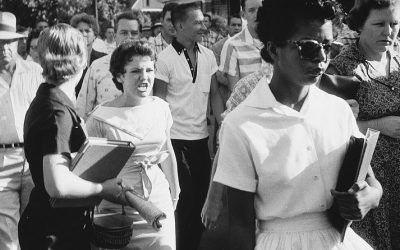
Desegregation at Little Rock’s Central High School in 1957
Last time in these pages I discussed the Supreme Court’s decision in the 1954 Brown v. Board of Education case, out of Topeka, Kansas. It attempted to rollback the premise that, if schools were “equal” in quality, then they may remain “separated” between blacks and...

Brown vs. Board of Education of Topeka, Kansas
In Topeka, Kansas, on February 20, 1943, a black girl named Linda Brown was born. When still a child in the early 1950’s, her father, Oliver Brown, was required to drive Linda to an all-black school five miles across Topeka, when an all-white school, the Sumner...

One of University of Northern Colorado’s 2020 Honored Alumni
William H. Benson
Local has provided scholarships for history students for 15 years
A Sterling resident is among five alumni selected to be recognized this year by the University of Northern Colorado. Bill Benson is one of college’s 2020 Honored Alumni.
Each year UNC honors alumni in recognition for their outstanding contributions to the college, their profession and their community. This year’s honorees were to be recognized at an awards ceremony on March 27, but due to the COVID-19 outbreak that event has been cancelled. Instead UNC will recognize the honorees in the fall during homecoming Oct. 10 and 11……
Newspaper Columns

The Duodecimal System
For centuries, the ancient Romans calculated sums with their clunky numerals: I, V, X, L, C, D, and M; or one, five, ten, 50, 100, 500, and 1,000. They knew nothing better.

The Thirteenth Amendment
On Jan. 1, 1863, President Abraham Lincoln signed the Emancipation Proclamation, and by it, he declared that “all persons held as slaves” within the rebellious states “are and henceforward shall be free.” Lincoln’s Proclamation freed some 3.1 million slaves within the Confederacy.

The Fourteenth Amendment
After Congress and enough states ratified the thirteenth amendment that terminated slavery, Congress passed the Civil Rights Act of 1866. This law declared that “all people born in the United States are entitled to be citizens, without regard to race, color, or previous condition of slavery or involuntary servitude.” The Act equated birth to citizenship.

The New-York Packet and the Constitution
Jill Lepore, the Harvard historian, published her newest book a month ago, These Truths: A History of the United States. In a short introduction, she describes in detail the Oct. 30, 1787 edition of a semi-weekly newspaper, The New-York Packet.
Mr. Benson’s writings on the U.S. Constitution are a great addition to the South Platte Sentinel. Its inspiring to see the history of the highest laws of this country passed on to others.
– Richard Hogan
Mr. Benson, I cannot thank you enough for this scholarship. As a first-generation college student, the prospect of finding a way to afford college is a very daunting one. Thanks to your generous donation, my dream of attending UNC and continuing my success here is far more achievable
– Cedric Sage Nixon
Donec bibendum tortor non vestibulum dapibus. Cras id tempor risus. Curabitur eu dui pellentesque, pharetra purus viverra.
– Extra Times
FUTURE BOOKS
- Thomas Paine vs. George Whitefield
- Ralph Waldo Emerson vs. Joseph Smith
- William James vs. Mary Baker Eddy
- Mark Twain vs. Billy Graham
- Henry Louis Mencken vs. Jim Bakker
