
By William H. Benson
The Parallel Lives
Of The NOBLE AMERICAN RELIGIOUS THINKERS AND BELIEVERS:
Roger Williams VS. Cotton Mathers

NEW ARTICLES
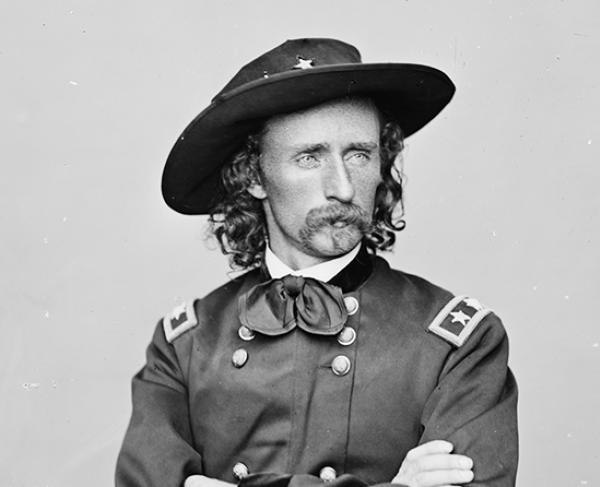
George Armstrong Custer
George Armstrong Custer
The Native American tribes had pet names for George Armstrong Custer. The Crow called him Child of the Morning Star, the Cheyenne labeled him Yellow Hair, but the Lakota Sioux referred to him as Long Hair, even though a barber had cut off his curly blond locks, days before his Last Stand.
A major general when the Civil War ended, but a Lieutenant Colonel during the Indian Wars in the Dakota’s and Montana, Custer harbored more lofty ambitions than only serving in the U. S. Army.
At least that is what Stephen E. Ambrose, a late twentieth-century U. S. historian, hinted at in his dual biography, Crazy Horse and Custer.
A strong Democrat, Custer was tired of seeing Republican administrations control the White House. Abraham Lincoln was first elected in 1860, then again in 1864, but then his Vice-President, Andrew Johnson, completed his second term after John Wilkes Booth assassinated Lincoln.
Former Army General U. S. Grant, a Republican, won election in 1868 and again in 1872, but his administration was marred by appalling scandals that soured the American public.
In the spring of 1876, the Democrats decided to hold their Presidential convention out west, in St. Louis, and scheduled it to begin on June 27. This time they wanted to pick a winner, and a few of the delegates began to think that a winning boy general, like Custer, only thirty-six, stood a fair chance.
Americans love their generals, men like George Washington, William Henry Harrison, Andrew Jackson, Zachary Taylor, and U.S. Grant, who all became a U.S. President.
Although anchorman in his graduating class of 1861, at West Point, 34th out of 34 graduates, Custer proved himself during the Civil War. He was at the first battle at Bull Run, at Antietam, at Gettysburg, in the ferocious Wilderness battle, and at Appomattox, the final battle.
He achieved fame by his daring style, by taking immense chances in battle and winning, and by riding his horse out in front of his famous 7th Cavalry.
Custer understood that he needed a decisive battle over the Sioux now, “if he wanted to stampede the Democratic Convention,” in St. Louis late in the month. Hence, he drove his men and his horses hard, mile after mile, day after day in those hot June days, into Montana.
“He told his favorite scout, Bloody Knife, and the Arikara scouts that he was planning to become the Great White Father,” in other words President of the United States.
When near the Sioux, Bloody Knife rode ahead and saw the enemy congregated on the Little Bighorn. He came away aghast, and told Custer to exercise caution, that “there were more Sioux ahead than the soldiers had bullets, enough Indians to keep the 7th Cavalry busy fighting for two days.”
Custer waved caution aside, and said that “the largest Indian camp on the North American continent is ahead, and I am going to attack it. I could whip all the Indians on the Continent with the 7th Cavalry.” The day was June 25.
That same day, Crazy Horse declared to his men, “It is a good day to fight! It is a good day to die!”
Instead of keeping his 611 men together, Custer divided them into four parts, a decision that proved a mistake, because the Sioux had as many as 3,000 warriors, and they were waiting for him.
Plus, Custer’s men were exhausted. Sitting Bull saw them and later said, “they were too tired. When they rode up, their horses were tired, and they were tired. When they got off from their horses they could not stand firmly on their feet. They swayed to and fro.”
Custer fought his final battle on a bluff above the Little Bighorn, renamed Custer’s Hill. The next year, a reporter from the New York Herald quizzed Sitting Bull who said, “Long Hair stood like a sheaf of corn with all the ears fallen around him. He killed a man when he fell. He laughed.”
The reporter asked, “You mean he cried out?” “No,” the chief said, “he laughed. He had fired his last shot.”
Stephen E. Ambrose wrote, “Custer had gambled all his life. It was a winner-take-all game, and Custer would have played it again if given the chance. He laughed. Then he died.”
Would a daredevil like Custer have made a good President? Ambrose wrote, “Custer probably would not have been much worse than the men who did hold the job for the remainder of the nineteenth century. The country would have survived.”
A quote that I read years ago, but could not find today, suggests that “the intelligence levels of the Presidents who followed Lincoln disproves evolution, the idea that a species progresses into a better, more capable living being.” It was not so with Hayes, Garfield, Arthur, Cleveland, and Harrison.
The Democratic candidate for President in 1876, Samuel Tilden, won the popular vote, but the election was thrown out because of charges of fraud. A commission gave the presidency instead to Rutherford B. Hayes, another Republican.
JOSEPH McCARTHY
JOSEPH McCARTHYJOSEPH McCARTHY by William H. Benson July 29, 1999 A dog which decides to bite its own hindquarters runs in a circle until it finally drops exhausted, even though you would think it knows better. History contains examples of this strange...
THE BATTLE AT SUMMIT SPRINGS
THE BATTLE AT SUMMIT SPRINGSTHE BATTLE AT SUMMIT SPRINGS by William H. Benson July 15, 1999 All of the great conflicts fought on North American soil hold a certain fascination and enchantment, but the Indian Wars are especially appealing, even though...
THOMAS PAINE
THOMAS PAINETHOMAS PAINE by William H. Benson July 1, 1999 A revolt against the existing government done with the hope of a new and potentially better government defines a revolution. The English Colonists on the Atlantic seaboard of the North American...
WATERGATE
WATERGATEWATERGATE by William H. Benson June 17, 1999 The "long national nightmare" began on June 17, 1972 as a bungled third-rate burglary into the Democratic National Party's sixth floor suite at the Watergate Hotel in Washington D.C. Captured in the act was...
TIANANMEN SQUARE
TIANANMEN SQUARETIANANMEN SQUARE by William H. Benson June 3, 1999 U.S. relations with the Communist Red Chinese once again are strained, the typical situation for Mao Tse Tung's revolutionary Red Chinese government, now in its fiftieth year. Three weeks ago...
FRANK SINATRA
FRANK SINATRAFRANK SINATRA The Voice was pure and pitch perfect. His stage presence was always the best. He knew when to breath and when not to, when to hold back and when to move ahead of the beat, and when to bridge the lines and phrases--anything to WOW the...
Older Posts
MARK TWAIN
MARK TWAINMARK TWAIN by William H. Benson April 22, 1999 Months before Mark Twain's demise, a newspaper erroneously ran an article announcing that he had already died. Invariably ready with a quick remark, he responded, "The reports of my death are greatly...
TITANIC
TITANICTITANIC by William H. Benson April 8, 1999 The Titanic departed the harbor at Southampton, England on April 10, 1912, and five days later she lay on the ocean floor. Of the 2340 passengers and crew, only 745, mostly women and children, survived to see...
SIR ROGER BANNISTER
SIR ROGER BANNISTERSIR ROGER BANNISTER Although the Marathon has become the most popular running event during the past twenty years, for many years track enthusiasts considered the mile run the event that fascinated them most. Today high school distance runners...
STONEHENGE
STONEHENGESTONEHENGE by William H. Benson March 25, 1999 Another spring is upon us, and with it baseball has arrived. (Will it be another homerun slugfest this year?) Green is showing up in the lawns, and the wheat fields already are a bright growing green. ...
WILLIAM SHAKESPEARE
WILLIAM SHAKESPEAREWILLIAM SHAKESPEARE by William H. Benson March 11, 1999 On Thursday, March 11, 1302, Romeo married Juliet, according to the English playwright, William Shakespeare. The newlyweds failed to celebrate even their first anniversary, for in the...
PERSIAN GULF WAR
PERSIAN GULF WARPERSIAN GULF WAR by William H. Benson February 25, 1999 Operation Desert Storm's aerial campaign began in mid-January 1991 and was immediately a success. Wave after wave of Allied bombers and missiles pounded Iraq's capital, Baghdad, and other...

One of University of Northern Colorado’s 2020 Honored Alumni
William H. Benson
Local has provided scholarships for history students for 15 years
A Sterling resident is among five alumni selected to be recognized this year by the University of Northern Colorado. Bill Benson is one of college’s 2020 Honored Alumni.
Each year UNC honors alumni in recognition for their outstanding contributions to the college, their profession and their community. This year’s honorees were to be recognized at an awards ceremony on March 27, but due to the COVID-19 outbreak that event has been cancelled. Instead UNC will recognize the honorees in the fall during homecoming Oct. 10 and 11……
Newspaper Columns

The Duodecimal System
For centuries, the ancient Romans calculated sums with their clunky numerals: I, V, X, L, C, D, and M; or one, five, ten, 50, 100, 500, and 1,000. They knew nothing better.

The Thirteenth Amendment
On Jan. 1, 1863, President Abraham Lincoln signed the Emancipation Proclamation, and by it, he declared that “all persons held as slaves” within the rebellious states “are and henceforward shall be free.” Lincoln’s Proclamation freed some 3.1 million slaves within the Confederacy.

The Fourteenth Amendment
After Congress and enough states ratified the thirteenth amendment that terminated slavery, Congress passed the Civil Rights Act of 1866. This law declared that “all people born in the United States are entitled to be citizens, without regard to race, color, or previous condition of slavery or involuntary servitude.” The Act equated birth to citizenship.

The New-York Packet and the Constitution
Jill Lepore, the Harvard historian, published her newest book a month ago, These Truths: A History of the United States. In a short introduction, she describes in detail the Oct. 30, 1787 edition of a semi-weekly newspaper, The New-York Packet.
Mr. Benson’s writings on the U.S. Constitution are a great addition to the South Platte Sentinel. Its inspiring to see the history of the highest laws of this country passed on to others.
– Richard Hogan
Mr. Benson, I cannot thank you enough for this scholarship. As a first-generation college student, the prospect of finding a way to afford college is a very daunting one. Thanks to your generous donation, my dream of attending UNC and continuing my success here is far more achievable
– Cedric Sage Nixon
Donec bibendum tortor non vestibulum dapibus. Cras id tempor risus. Curabitur eu dui pellentesque, pharetra purus viverra.
– Extra Times
FUTURE BOOKS
- Thomas Paine vs. George Whitefield
- Ralph Waldo Emerson vs. Joseph Smith
- William James vs. Mary Baker Eddy
- Mark Twain vs. Billy Graham
- Henry Louis Mencken vs. Jim Bakker
