
By William H. Benson
The Parallel Lives
Of The NOBLE AMERICAN RELIGIOUS THINKERS AND BELIEVERS:
Roger Williams VS. Cotton Mathers

NEW ARTICLES
Explo ’72
Explo ’72
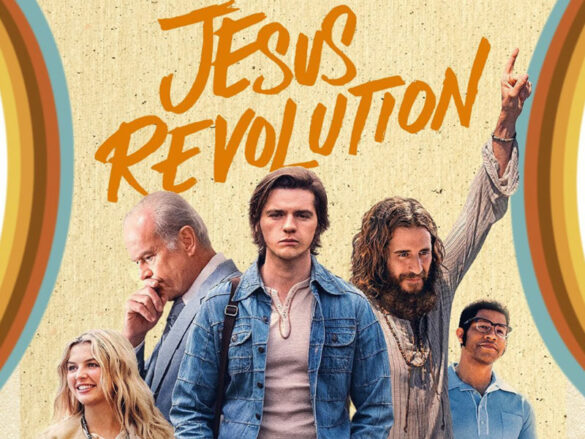
This last week I watched the new Lionsgate film, “Jesus Revolution.” The film did better than expected, grossing $50 million in the first months after its release in February.
The screenplay is based upon a memoir that Greg Laurie, and co-writer Ellen Vaughn, published in 2018, “Jesus Revolution: How God Transformed an Unlikely Generation and How He Can Do It Again Today.”
I knew nothing of Greg Laurie when I watched the movie, but since then, I have learned that he is a long-time pastor, fifty years now, at a megachurch called Harvest Christian Fellowship in both Riverside and Irvine, California.
The screenplay includes four people: Greg, his girlfriend Cathe, a charismatic bearded hippy named Lonnie Frisbee, and a former Foursquare pastor named Chuck Smith.
In the early 1970s, Greg was in high school and lived with his alcoholic mother in a trailer house parked at Newport Beach. Throughout the film, he struggles to find his way, to re-create a more stable home and family, and find a career.
He heads down the wrong path for a short time, but other people, including Cathe, Lonnie, and Chuck, redirect him.
Lonnie and Chuck agree to conduct a mass baptism on a Saturday at Pirate’s Cove, at Newport Beach. Over the next several weeks, the two men baptize hundreds and then thousands of young people in the Pacific Ocean, including Cathe and Greg.
A break between Lonnie and Chuck over the appropriate style of worship at Calvary Chapel forces Greg to choose between them. Lonnie heads to Florida.
It is the film’s final scene that resonated with me. It is that of Explo ‘72, in Dallas, Texas, a gathering sponsored by Bill Bright’s organization “Campus Crusade for Christ.”
High school and college-aged students from across America showed up from June 12 to June 17, 1972, for a week of training in mission work, fifty-one years ago this month.
Three weeks after I graduated from Sterling High School, in May, I made the trek to Dallas. My ride dropped me off at Dallas Baptist College, and I checked into a dorm.
Days we attended seminars on campus, where instructors tried to teach us how to minister door-to-door, by passing out tracts. Afternoons we knocked on doors.
Towards evening, city buses would haul us to the Cotton Bowl, where we listened to a series of vocalists, bands, and sermons, including Johnny Cash, Kris Kristofferson, and Andre Crouch. Billy Graham spoke mid-week.
The final scene of “Jesus Revolution” shows a clip of Billy speaking to a crowd of almost 80,000 students, in the Cotton Bowl. He wore a powder blue suit, white shirt, and tie.
In that clip, he says, “This is a demonstration of the love of God by tens of thousands of young people, saying to the world that God loves you. It’s the Jesus revolution that is going on in this country.” Pictures of the actual Greg, Cathe, Lonnie, and Chuck follow.
At Explo ‘72, I did not see many, if any, hippies or flower children, like those seen at Haight-Ashbury in San Francisco. Those who attended were typical high school and college-aged students, who wore normal clothes, shoes, and sported no beards.
I think the film makes a mistake by conflating as the same two distinct organizations, Chuck and Lonnie’s “Jesus Movement” in southern California, and Bill Bright’s “Campus Crusade for Christ,” a college-oriented ministry spread across the fifty states.
In all, I thought the movie was worth watching. Kathy Schiffer, a journalist, said, “If you’re old enough to remember the 1960s and ’70s, you’ll find Lionsgate’s upbeat new film ‘Jesus Revolution’ to be a walk down memory lane.” Indeed, it was, especially the music.
I might mention that Kelsey Grammer, of “Cheers” and “Frasier,” plays Chuck Smith, and that Jonathan Roumie, of “The Chosen” television series, plays Lonnie Frisbee.
LINCOLN AND GENIUS
LINCOLN AND GENIUSLINCOLN AND GENIUS by William H. Benson February 8, 2007 A week ago on Sixty Minutes, Morley Safer interviewed Daniel Tammet, a twenty-eight-year old autistic savant living in Kent, England. Daniel holds the European record for memorizing pi,...
BILLY GRAHAM
BILLY GRAHAMBILLY GRAHAM by William H. Benson January 25, 2007 In September of 1936, sixty years ago, a North Carolina farmer drove his seventeen-year old son west across the Appalachians to Cleveland, Tennessee to enroll as a freshman in Bob Jones College. The...
COMMON SENSE
COMMON SENSECOMMON SENSE by William H. Benson January 11, 2007 In last Sunday’s New York Times “Book Review” section, P. J. O’Rourke reviewed Adam Smith’s massive work on economics The Wealth of Nations, first published in 1776. The publisher’s idea was to give...
WORDS
WORDSWORDS by William H. Benson December 28, 2006 At the encouragement of a family member, I slowed down for two hours last Friday night to watch a video: Alkeelah and the Bee, and strangely enough, I liked it. It is the fictional story of Akeelah Anderson, an...
WAR AND PEACE
WAR AND PEACEWAR AND PEACE by William H. Benson December 14, 2006 The calendar tells us that we are midway between Pearl Harbor and Christmas, between War and Peace, between an attack upon a Pacific Island and Advent. The history of the world constantly...
READING AND WHY
READING AND WHYREADING AND WHY by William H. Benson November 30, 2006 Today, November 30th, marks the birthdays of three celebrated writers: Jonathan Swift in 1667, Mark Twain, in 1835, and Winston Churchill in 1874. Jonathan Swift, an English Protestant...
Older Posts
REVOLUTION IN HUNGARY
REVOLUTION IN HUNGARYREVOLUTION IN HUNGARY by William H. Benson November 16, 2006 Josef Toth’s mother passed away in 1954, weeks after her return from a six-month prison confinement, courtesy of the AVO, Hungary’s state police. She had spoken out against the...
ALGERIA, AFGHANISTAN, AND VIETNAM
ALGERIA, AFGHANISTAN, AND VIETNAMALGERIA, AFGHANISTAN, AND VIETNAM by William H. Benson November 2, 2006 Algeria’s rebel army initiated its revolution against the French forces on November 1, 1954, fifty-two years ago. It required eight years but the FLN, the...
YORKTOWN AND LEWIS AND CLARK
YORKTOWN AND LEWIS AND CLARKYORKTOWN AND LEWIS AND CLARK by William H. Benson October 19, 2006 Writing teachers tell us that authors build their most successful stories upon one of two themes: a stranger comes to town or somebody goes on a journey. In each...
MULTICULTURALISM
MULTICULTURALISMMULTICULTURALISM by William H. Benson September 21, 2006 Serendipity catches us unaware. It brings us up short. It happens when we go to watch a fight, and right in the middle of it an ice hockey game breaks out. We are astonished when...
PRESIDENTIAL PARDONS
PRESIDENTIAL PARDONSPRESIDENTIAL PARDONS by William H. Benson September 7, 2006 “The quality of mercy is not strain’d; It droppeth as the gentle rain from heaven upon the place beneath. It is twice blest: It blesseth him that gives and him that takes.” So said...
PLAY
PLAYPLAY by William H. Benson August 24, 2006 The fall sports season at the high schools is now in full swing. The schedules are set, and participants will soon play their first games or compete at their first matches and meets. Some will win, others will lose,...

One of University of Northern Colorado’s 2020 Honored Alumni
William H. Benson
Local has provided scholarships for history students for 15 years
A Sterling resident is among five alumni selected to be recognized this year by the University of Northern Colorado. Bill Benson is one of college’s 2020 Honored Alumni.
Each year UNC honors alumni in recognition for their outstanding contributions to the college, their profession and their community. This year’s honorees were to be recognized at an awards ceremony on March 27, but due to the COVID-19 outbreak that event has been cancelled. Instead UNC will recognize the honorees in the fall during homecoming Oct. 10 and 11……
Newspaper Columns

The Duodecimal System
For centuries, the ancient Romans calculated sums with their clunky numerals: I, V, X, L, C, D, and M; or one, five, ten, 50, 100, 500, and 1,000. They knew nothing better.

The Thirteenth Amendment
On Jan. 1, 1863, President Abraham Lincoln signed the Emancipation Proclamation, and by it, he declared that “all persons held as slaves” within the rebellious states “are and henceforward shall be free.” Lincoln’s Proclamation freed some 3.1 million slaves within the Confederacy.

The Fourteenth Amendment
After Congress and enough states ratified the thirteenth amendment that terminated slavery, Congress passed the Civil Rights Act of 1866. This law declared that “all people born in the United States are entitled to be citizens, without regard to race, color, or previous condition of slavery or involuntary servitude.” The Act equated birth to citizenship.

The New-York Packet and the Constitution
Jill Lepore, the Harvard historian, published her newest book a month ago, These Truths: A History of the United States. In a short introduction, she describes in detail the Oct. 30, 1787 edition of a semi-weekly newspaper, The New-York Packet.
Mr. Benson’s writings on the U.S. Constitution are a great addition to the South Platte Sentinel. Its inspiring to see the history of the highest laws of this country passed on to others.
– Richard Hogan
Mr. Benson, I cannot thank you enough for this scholarship. As a first-generation college student, the prospect of finding a way to afford college is a very daunting one. Thanks to your generous donation, my dream of attending UNC and continuing my success here is far more achievable
– Cedric Sage Nixon
Donec bibendum tortor non vestibulum dapibus. Cras id tempor risus. Curabitur eu dui pellentesque, pharetra purus viverra.
– Extra Times
FUTURE BOOKS
- Thomas Paine vs. George Whitefield
- Ralph Waldo Emerson vs. Joseph Smith
- William James vs. Mary Baker Eddy
- Mark Twain vs. Billy Graham
- Henry Louis Mencken vs. Jim Bakker
